
Introduction
As the global climate conversation intensifies, businesses are under increasing pressure to take responsibility for their greenhouse gas (GHG) emissions. Carbon accounting is no longer a niche sustainability effort—it’s a strategic business requirement.
To manage this responsibility effectively, organisations turn to internationally recognised frameworks like ISO 14064 and the Scope 1, 2, and 3 emissions classification. These standards not only help measure and report emissions but also support regulatory compliance, ESG performance, and carbon reduction planning.
At PGS Energy Services Private Limited (PGSEPL), we assist organisations in adopting these frameworks to drive transparency, efficiency, and credibility in their climate journey.
What is ISO 14064?
ISO 14064 is a globally accepted standard developed by the International Organisation for Standardisation. It provides clear specifications and guidance for the quantification, monitoring, reporting, and verification of greenhouse gas emissions and removals.
ISO 14064 is divided into three parts:
- ISO 14064-1: Guidelines for organisations to develop GHG inventories and report emissions and removals.
- ISO 14064-2: Focuses on project-level activities that reduce or remove emissions.
- ISO 14064-3: Outlines requirements for independent verification and validation of GHG assertions.
This standard helps organisations ensure that their carbon reporting is accurate, consistent, and comparable across industries and regions.
Understanding Scope 1, 2, and 3 Emissions
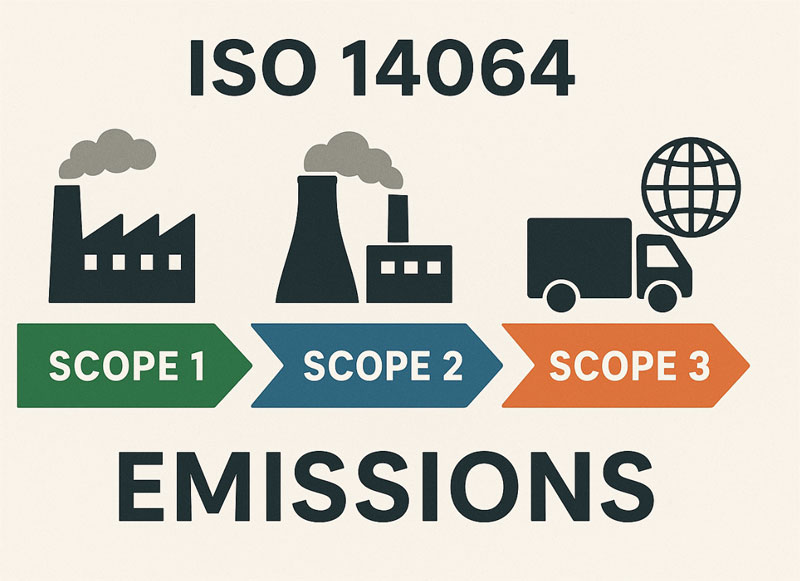
To fully account for an organisation’s carbon footprint, emissions are divided into three categories, or “scopes”:
Scope 1: Direct Emissions
These are emissions from sources that are owned or directly controlled by the organisation.
Examples include:
-
- Fuel combustion in company-owned vehicles
- Emissions from industrial processes
- On-site boilers, generators, or furnaces
Scope 2: Indirect Emissions from Energy
These emissions result from the generation of purchased electricity, heating, cooling, or steam that the organisation consumes.
Examples include:
-
- Electricity purchased from a coal-powered grid
- Outsourced cooling systems
Scope 3: Other Indirect Emissions
Scope 3 includes all indirect emissions that occur in the organisation’s value chain, both upstream and downstream.
Examples include:
- Business travel
- Employee commuting
- Supply chain emissions
- Waste disposal
- Use of sold products
Scope 3 emissions are often the largest and most complex to calculate, but they provide a full picture of an organisation’s environmental impact.
Why ISO 14064 and Scopes Are Important Together
Using ISO 14064 in conjunction with Scope 1, 2, and 3 classifications provides organisations with a comprehensive, systematic, and verifiable approach to managing GHG emissions.
Benefits include:
- Increased transparency in carbon reporting
- Better decision-making for carbon reduction strategies
- Improved ESG performance and investor confidence
- Readiness for regulatory compliance and carbon markets
- Credibility in sustainability claims and disclosures
PGSEPL’s Role in Carbon Management
At PGS Energy Services (PGSEPL), we specialise in helping organisations meet their carbon goals through a combination of auditing, verification, consulting, and reporting services.
Our services include:
ISO 14064 Consulting & Implementation
- Establish GHG inventory systems
- Conduct Scope 1, 2, and 3 emissions assessments
- Train teams in ISO-compliant reporting.
GHG Verification (ISO 14064-3)
- Independent third-party verification of carbon data and reduction claims
- Support for generating verified carbon credits
Energy Audits & Reduction Planning
- Identify direct and indirect energy-saving opportunities
- Address Scope 1 and 2 emissions at the source
Scope 3 Mapping & Strategy
- Value chain emissions analysis
- Design low-carbon procurement and operational strategies
ESG & Sustainability Reporting
- Align disclosures with SEBI BRSR, GRI, CDP, and other frameworks
- Integrate carbon data into corporate ESG goals
- Case for Businesses in India
With India’s growing emphasis on sustainability and evolving regulations (e.g., the SEBI BRSR mandate), businesses across sectors must prepare to disclose and reduce their emissions footprints.
Whether you’re:
- A manufacturing company under the CCTS/PAT scheme
- A listed company responding to investor ESG expectations
- A growing enterprise aiming for carbon neutrality
…you can benefit from adopting ISO 14064 and scope-based emissions tracking as a foundation for long-term climate action.
Conclusion
Carbon transparency is no longer a choice — it’s a business imperative. Standards like ISO 14064 and the Scope 1, 2, and 3 emissions model provide the structure and credibility organisations need to navigate climate challenges confidently.
At PGSEPL, we are proud to support industries in quantifying, verifying, and reducing their carbon footprint through internationally recognised best practices. With our expertise in carbon accounting, energy auditing, and ESG reporting, we help organisations turn climate responsibility into competitive advantage.